NATIONWIDE STEM TEACHER TRAINING EMPOWERS EDUCATORS IN CBE REFORM
Дата и время
Время начала
Время окончания
Место
Описание
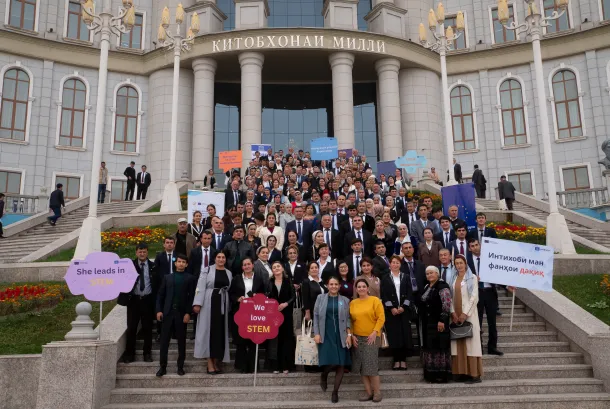
As part of the EU-funded project “Strengthening Competency-Based and ICT-Enabled STEM and VET Education and Teacher Training in Tajikistan,” UNESCO, in collaboration with the Ministry of Education and Science of the Republic of Tajikistan and the Republican In-service Teacher Training Institute (RITTI), conducted a comprehensive professional development training for STEM teachers and methodologists from all regions of the country.
The training took place at the National Library of Tajikistan and School No. 65 in Dushanbe, aiming to bring together 335 in-service Physics, Chemistry, and Biology teachers from across the country. The workshop marked a major milestone in the nationwide rollout of Tajikistan’s revised competency-based STEM curricula, aligning closely with the National Strategy for Education Development until 2030 and Sustainable Development Goal 4 on quality education.Key themes included the 5E instructional model, functional literacy, inclusive education, and modern assessment tools. Teachers explored personalized learning strategies, participated in scenario-based learning activities, and designed classroom tasks aligned with specific learning outcomes. Dedicated sessions emphasized the integration of ICT in teaching and laboratory work, fostering student engagement through hands-on experimentation and inquiry-based learning.
The training also highlighted gender and inclusion in education. Through discussions and practical exercises, teachers reflected on classroom dynamics, gender stereotypes, and strategies to create a supportive and equitable learning environment for all students. International experts provided mentoring and technical support, observing sessions and offering feedback to ensure the quality and sustainability of the training. Facilitators from RITTI, previously trained under the same EU-funded initiative, led the sessions, further strengthening the national capacity for ongoing professional development.
This workshop represents a significant step forward in Tajikistan’s education reform efforts. By empowering educators with new competencies, tools, and mindsets, the initiative helps bridge the gap between policy and practice—supporting the development of a modern, inclusive, and high-quality education system in Tajikistan.
The programme focused on equipping teachers with innovative instructional strategies, deepening their understanding of the competency-based approach, and strengthening their capacity to apply gender-responsive, ICT-integrated teaching in real classroom settings. Participants engaged in interactive sessions, microteaching, peer learning, and collaborative lesson planning—all based on the newly developed STEM textbooks, teacher guides, and assessment tools for Grades 7–11.